



At our Afterwork event in April about AI and innovation, we shared how AI glasses are now open for builders.
AI
May 27, 2026
—
5 min
READ
Demo: live presentation building with AI glasses

I didn't prepare any slides for my talk at our Afterwork event on AI and innovation. Not a single one. Instead, I walked on stage wearing a pair of Meta Ray-Bans Display and asked them to build the presentation for me. Live, in front of a few hundred people.
It worked!
The moment that always lands
A few seconds in, Claude (running locally on my laptop) asked me who the audience was. So I said: "Take a picture of the room and tailor the presentation." The glasses clicked. The photo went up.
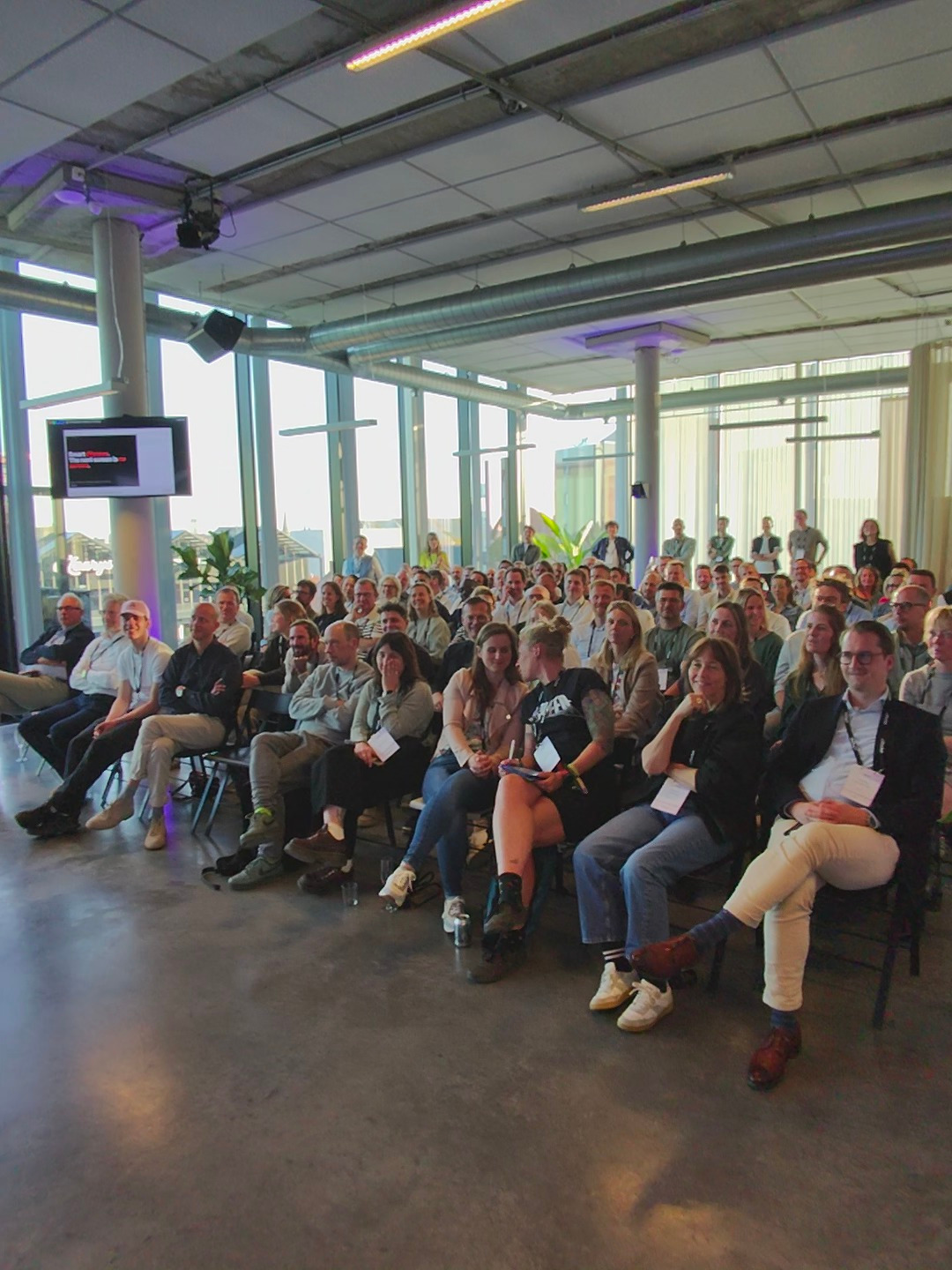
A few seconds later the slide rewrote itself with audience-themed chips: builders, leaders, makers. Tech crowd. Lanyards everywhere.
That beat never gets old. The AI asked a question, I answered it the way I'd answer anyone else, and the room watched a webpage redesign itself around them.

Why I built it live
Here's the thing I actually wanted to argue: smart glasses plus AI is no longer a tech curiosity. It's a building platform. Hands-free input, vision, multimodal output, and enough context to ship things on top of.
I could have made that case with slides. I could have brought screenshots. But there's a much better way to argue a platform is ready: use it.
If the talk got built in front of you, voice-only, in real time, then whatever cool experience you're sketching on the back of an envelope is probably buildable too.
That's the whole point.
What's under the hood
The pipeline is shorter than you'd think:
1. Meta Ray-Bans capture voice, and a picture when I ask. They talk to my phone over Meta's DAT SDK.
2. An Android app I built opens a WebSocket to a small bridge server on my laptop and streams audio.
3. The bridge runs faster-whisper small.en for speech-to-text and Kokoro-82M for text-to-speech. Both run on the laptop. No cloud STT or TTS.
4. Claude Code sits behind the bridge. It edits a Vite project (HTML, CSS, JS), and Vite hot-reloads the page on the screen behind me.
5. The presentation is just `localhost:5173` projected. No slide engine. No PowerPoint.
The only thing leaving my laptop is the LLM call to Claude. Everything in between, voice in and voice out, runs on-device.
The trick: skills and context
Anyone can get an AI to build a webpage. The reason this didn't feel like a generic AI demo is that I gave Claude two things it didn't have out of the box.
First, an ITP brand skill and an ITP content skill. These are internal Claude skills that hold our design system and our writing voice.
Second, our AI Product Playbook PDF, embedded in the project so Claude could ground its language in the four pillars we publish on.
One voice command, "Use the ITP brand skill and the ITP content skill to restyle and rewrite", and the slide jumped from generic AI aesthetic to something that looked like it shipped from our studio.
This is the unsexy point of the whole demo. AI is a commodity. Your domain knowledge is not. Plug your house style and your published knowledge into the loop, and the output stops looking like every other AI build.
Every run was different
I rehearsed this a lot. Every single dry run produced a different welcome slide. Different palette, different layout, different headline. Some were great. Some were cursed.

Nine of them, side by side. Same prompt, nine outputs. Different visuals, different copy, but always about smart glasses. That variance is the whole reason live demos with this kind of stack are simultaneously unnerving and fun. There's no "version we settled on". There's just whatever the AI feels like making today.
Why I think this matters
We've been here before. The iPhone shipped as a gadget for early adopters. The day they opened the SDK to builders, we built for the brands people use every day: Engie, Bancontact, Itsme, Daikin. The hardware didn't make that possible. The access did.
Smart glasses just opened that door. Meta Ray-Bans for builders, vision, on-device sensors, AI at your eyes and ears. Hands-free is a big deal in any role where your hands are already busy: lab assistants, field technicians, manufacturing floors, museum guides.
I think we're at the beer app stage of this platform. That's the fun stage. The one before everyone gets serious.
One small cheat
Two things I should come clean about.
The Meta Ray-Ban Display glasses have a tiny in-lens display, so I ran a teleprompter app on them. The audience saw nothing, but I could glance at my next prompt without breaking eye contact.
And while I didn't write a single line of demo code in advance, I did rehearse the steps: which voice commands to give, in what order, with fallback prompts if Claude went off the rails. The output was live. The script was not.

I'll let the AI close
At the end of the talk, I gave Claude one last voice command: deliver the sales pitch. Voice only, no slide changes. If it could build the whole presentation, I figured it could probably handle the close too.
Here's what it said:
> Smart glasses are the next computing surface. The hardware is here. The AI is here. The user behaviour is shifting fast. Early movers will own the playbook. Plug into a team that knows how to bridge AI, design and real-world UX, and get to market while everyone else is still reading think pieces. The window is open. Let's build something your users will wear every day.
That last line is the AI's. I'd close on it too. If you're building anything in this space, let's talk.
Stay ahead
of the game.
Sign up for our monthly newsletter and stay updated on trends, events and inspiring cases.
Thank you! Your submission has been received!
Oops! Something went wrong while submitting the form.