




Building a unified app and cloud platform for Daikin Europe
Daikin Europe NV is a subsidiary of the global group Daikin Industries Ltd and the leading provider of heating, cooling, ventilation, air purification and refrigeration technology. Over the years, its digital landscape became fragmented: separate apps controlled different product lines and each app talked to its own backend. Working alongside Daikin Europe, In The Pocket consolidated this with Onecta, a unified mobile app built with React Native, and Onecta Cloud, a microservices-based platform on AWS. Together, they give customers one place to control every device and give Daikin a scalable, cost-efficient foundation that now manages million of devices.

The challenge
A fragmented digital ecosystem causing inconsistent experiences, high maintenance overhead and scalability issues.
Solution
Onecta, a single mobile app for every device, and Onecta cloud, a unified backend.
Approach
React Native app with a reusable design system, tested on real and simulated devices.
Outcome
A platform supporting millions of devices, simpler maintenance, better scalability and faster partner integrations.
01 — CHALLENGE
Fragmented apps and different backends
As Daikin Europe's product portfolio grew, so did fragmentation. Separate apps supported heating and cooling products, each with its own backend. Customers had to switch between apps, the design varied and simple tasks were hard to find. An older system could not keep up with demand, so engineers were adding servers and juggling capacity.
Running several apps also duplicated development and testing. Some systems were managed by suppliers, which limited Daikin Europe’s control and slowed design refreshes and product improvements. Different apps meant different plans and release cycles, so behaviour varied across product families and features that should work across devices were difficult to deliver.
At the same time, Daikin Europe wanted to connect with other smart home platforms and build new, energy-focused services, which was hard with everything split up.
There was also a cultural shift to make. As Pieter Vanden Berge, Project Lead at Daikin Europe, says: "At Daikin, our expertise lies in building robust heat pumps that operate with water, air, and refrigerants. Traditionally, installers have prioritised the mechanical setup of new Daikin units in customers’ homes, with less emphasis on connectivity through smartphone applications." Moving to connected products meant making sure that the app onboarding is a smooth experience.
For customers, the pain was clear. “We had different apps for the heating and cooling products,” Pieter recalls. “Internally, the digital landscape was fragmented, which also impacted the experience for end customers. The existing applications had become outdated and were no longer able to meet evolving user expectations. There was a clear demand for a more cost-efficient and user-friendly solution,” he adds.
Recognising these challenges, Daikin Europe identified the need for a strategic digital partner with deep expertise in app development and scalable cloud solutions. By collaborating with external specialists, Daikin Europe ensured the delivery of a robust, future-ready platform capable of supporting millions of users, and adapting to evolving market needs.

02 — SOLUTION
One app, one cloud, all Daikin
Daikin Europe and In The Pocket solved the fragmentation with two pillars: a single mobile app and a single cloud platform working across the full product range.
Onecta app
- One app for all devices: A single control centre for every Daikin device. Selecting one reveals only relevant controls.
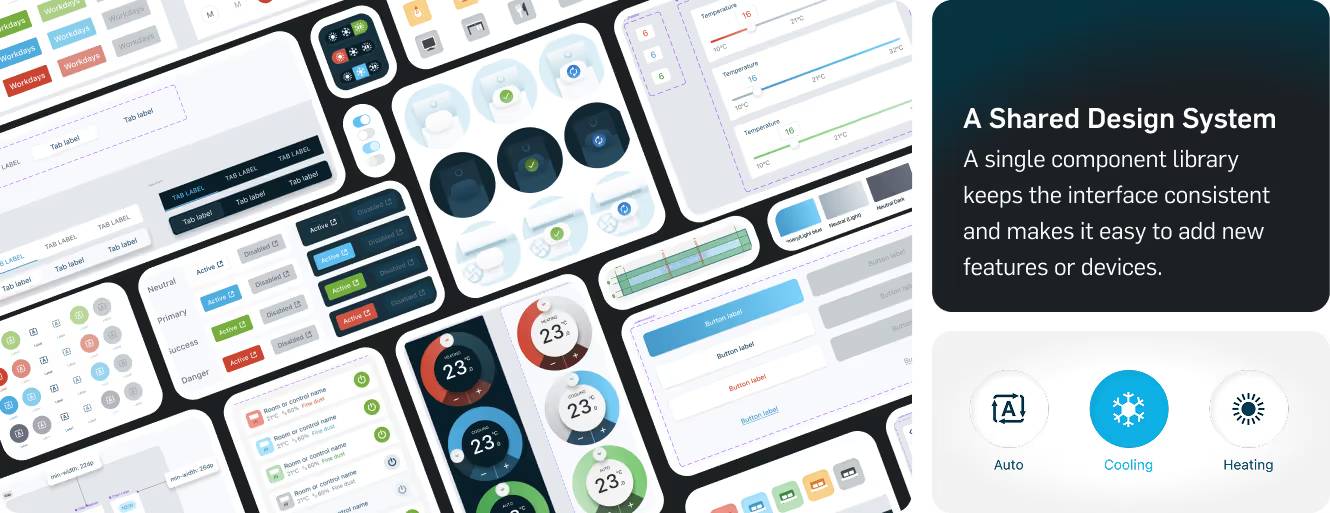
- Consistent design: Building on earlier app work for the company, we implemented a design system so core components, animations and flows are defined once and reused throughout.
- React Native foundation: One codebase for iOS and Android speeds up delivery and ensures feature parity.
- Internationalisation and accessibility: Support fort tens of languages all across the world, including left-to-right and right-to-left scripts.
- Tested on real hardware: Real and simulated devices cover commissioning, edge cases and connectivity.
- User-centred onboarding: “Onboarding was designed to feel as pleasant as possible.” explains Pieter. “Onecta is the main interface for Daikin’s residential users,” he continues, “with the goal of being the one app that all our residential customers actually use to control the Daikin equipment they have in their home, and some other equipment as well.”
By bringing everything into one place, Onecta makes the connected home simple today and leaves room for new devices tomorrow.
Onecta cloud
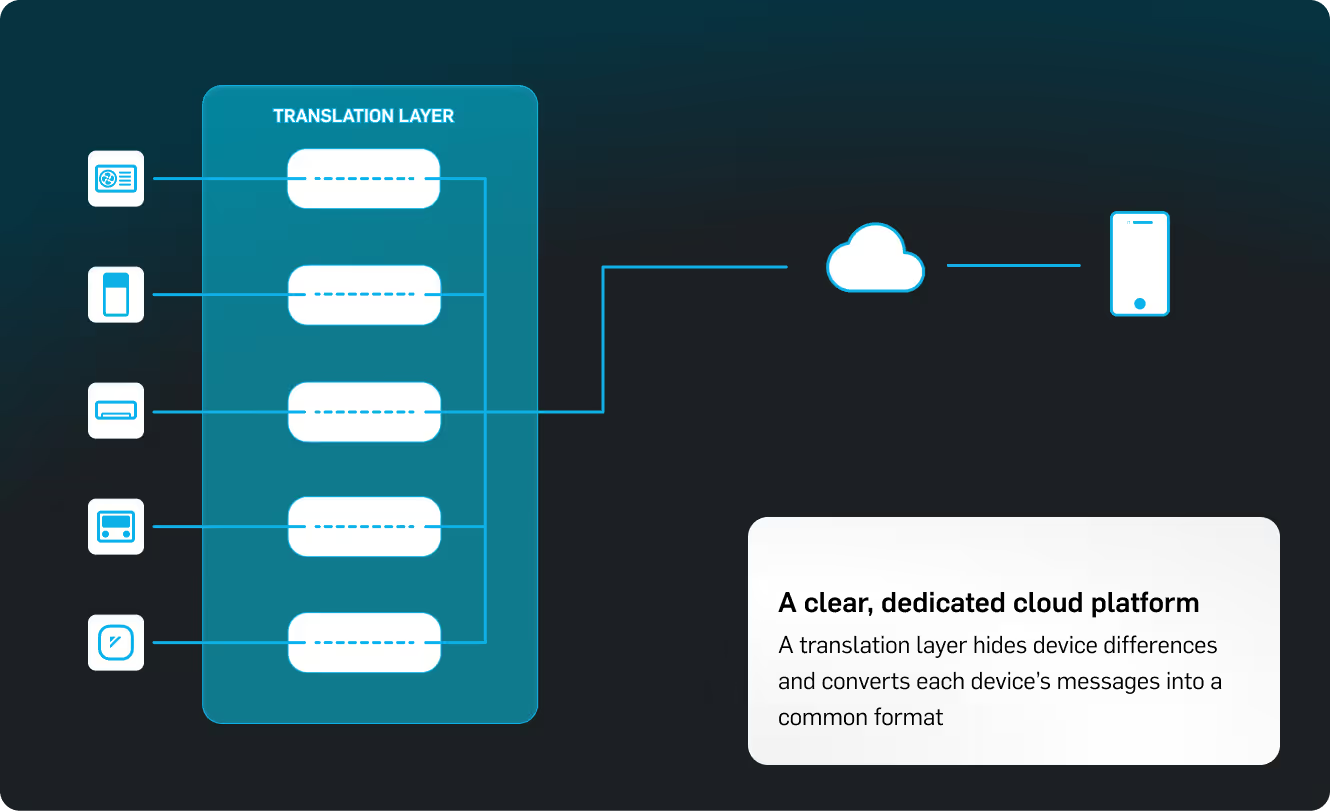
Behind the app sits a dedicated cloud platform on AWS. Instead of scattered vendor systems, every device now speaks to a central layer that handles communication consistently.
- Unified backend: A cloud-native platform with modular, microservices-based architecture. Devices communicate through device-specific rules into a central services layer.
- Clear, stable communication: A translation layer hides device differences and converts messages into a common format.
- Resilience and scalability: Microservices and serverless components handle ingestion, processing and storage. Automated end-to-end tests, monitoring and logging ensure reliability and faster diagnosis.
- API governance and partner readiness: A managed API layer with gateways and a developer portal sets clear rules for access and security so third-party platforms can integrate safely.
Together, the Onecta app and Onecta cloud turn a complex estate into a single, dependable experience for customers and a solid platform for Daikin Europe’s next steps.
03 — APPROACH
Bridging hardware discipline with software speed
Delivering Onecta meant rethinking the technical setup and how the teams worked. Daikin Europe and ITP built mixed squads, set a steady release rhythm, and agreed clear touchpoints so everyone knew who did what and when.
Design and development
- Blended teams and steady releases: Multidisciplinary squads brought app developers, cloud engineers, architects and product managers together. “Adapting ITP’s agile habits to a hardware-led organisation was a long process, but regular releases, open communication and clear checkpoints helped both sides meet in the middle,” shares Pieter.
- Bridging hardware and software: Daikin Europe has a background of staged hardware development, where quality and reliability are key. Together we mapped that mindset onto agile software practice. Over time, the teams set a continuous release cadence and a test framework that runs hundreds of checks on new builds, balancing hardware-level reliability with software speed.
- Shifting effort from app to cloud: Early on, the app team was larger. As the Onecta app matured, most new features moved into the cloud.
- Iterative roadmap planning: Each year, Daikin Europe’s business units and ITP prioritise new features based on market demand and long-term goals. Yearly plans set direction; architects and engineers then choose an approach that meets today’s needs without limiting tomorrow’s options.
- Release cycle and testing: Beyond the lab of real and simulated devices, automated suites run on every release. As Pieter puts it: “We run it against hundreds of test cases and see if everything still works. It’s a continuous testing process.”
- Clear roles and communication: Regular touch points and ownership lines reduced noise. “Team leads support developers so they are not bothered every five minutes,” says Pieter.
Technical foundations
- React Native and a shared design system: A single component library keeps the interface consistent and makes it easy to add new features or devices. One codebase serves iOS and Android.
- Amazon Web Services with small, independent services: Durable storage, strong monitoring and clear logs for quick diagnosis.
- One interface to many suppliers: A translation layer hides device differences and gives the app a single, similar look and feel for any Daikin device regardless of what type of unit it is.
- Managed APIs for partners: Standard gateways and policies handle access and security for internal teams and external partners, laying the ground for future cloud-to-cloud integrations.
04 — OUTCOME
Built for today, ready for tomorrow
The Onecta app and Onecta cloud have reshaped Daikin Europe's connected ecosystem. Customers get one simple experience. The business gets a platform that scales and is ready for what comes next.
- Unified customer experience: One app with a consistent interface replaces multiple tools. Control is simpler, and new features reach users faster.
- Strong ratings and adoption: 4.57 in the App Store and 4.39 in Google Play, live in 70+ countries.
- Built for scale: 2M+ devices connected. Most customers own around two devices, and households often have several users. Capacity can grow without slowing the experience.
- Operational efficiency: On-demand cloud services replace manual server work. Monitoring and logging shorten incident response. The translation layer hides device differences, so new device types can be added faster and at lower cost.
- Integration-ready: Standard APIs and clear rules make it safer and quicker to connect third-party platforms, opening the door to future energy services.
Developer interest has shifted from the app to the platform. “More and more people are interested not just in the app, but in the APIs as well,” says Pieter. Expectations have also changed. “Seven to ten years ago, IoT was a niche. Now people expect any device to be connected and work seamlessly and efficiently.”
The scale is already visible. “We have millions ofdevices connected,” he notes. “Fast onboarding and solid capacity keep the experience consistent whether there are five devices online or two million,” he shares.
Daikin Europe's project lead sums up the value of collaborating with In The Pocket: “The ITP team is always trying to be up to date with new trends, testing platforms in beta and making sure libraries are updated before any issues arise. That gives you peace of mind that things will always work.”
Looking ahead
Pieter views the cloud platform as a foundation for future innovation: “We are committed to ensuring a robust and lasting platform for every user. Any Daikin device can be managed through a single mobile application, with the potential to seamlessly integrate with third-party solutions.” The overarching goal is a seamless user experience: “When a customer purchases a new Daikin device, they can access and control it securely with just a few simple taps on their phone.”
This collaboration is what happens when hardware discipline meets software speed. Mixed teams, steady releases and real hardware in the loop produced one coherent experience at global scale.

.avif)


Fulfill your ambitions
We'd love to hear about your next challenges. Let's take the first step towards achieving your business goals. No strings attached.
Let's chat