





Most organisations adopt AI quickly but see little real productivity impact because they plug it into old structures instead of redesigning how work gets done. True AI transformation requires clear ownership of business capabilities, a shared and governed AI platform, and continuous investment in people and habits. The companies that win are not experimenting more, they are changing their organisation around AI faster and more deliberately. That is how AI moves from exciting pilots to measurable results.
AI
December 9, 2025
—
4
READ
How to avoid AI’s 'productivity problem'
As I walked on stage at Tectonic to talk about AI, I had one question in mind: “If everyone is buying AI, why are so few companies seeing real results?”
In other words, AI adoption is everywhere, but true AI maturity is rare and most organisations still lack a clear AI adoption strategy.
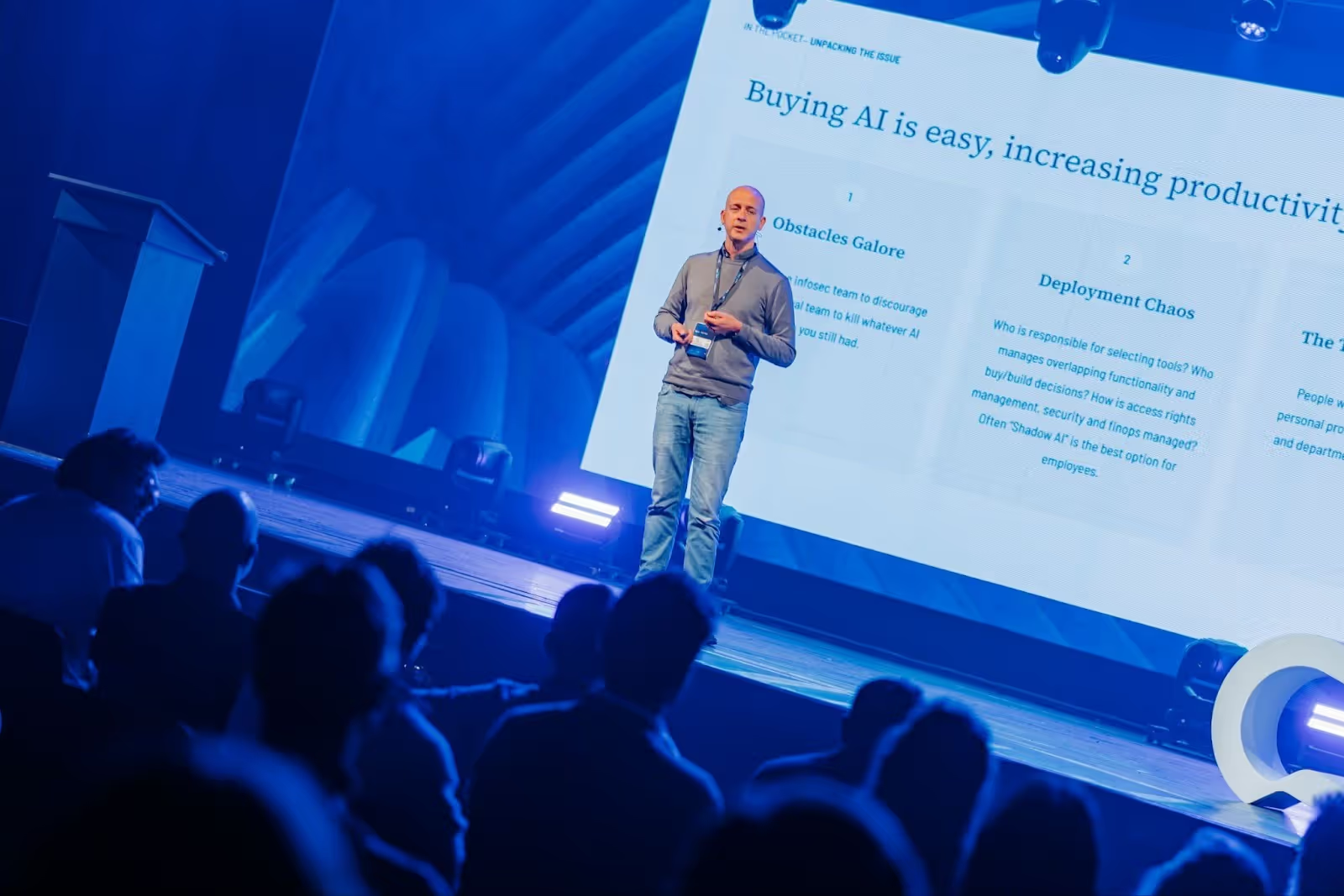
I do not think this is an AI problem, but a pattern we have seen before.
We’ve Been Here Before
In the late 1980s, economists noticed something strange. Computers were showing up everywhere, but not in the productivity statistics.
The same thing happened even earlier with electricity in factories. Owners pulled out the steam engine, installed an electric dynamo and kept everything else the same. Same layout, same processes, same roles. It took decades before people redesigned the factory around electricity with smaller machines, new skills and different flows of work. That is when productivity finally jumped.
We are now doing the same with AI. We talk about artificial intelligence transformation, but in reality most organisations are only experimenting at the surface.
We plug AI into old structures, keep the same teams and targets, and hope for magic. People feel more productive, but at the company level, the P&L barely moves while the AI bill grows.
Buying AI is Easy, Changing Habits is Hard
Today, adoption is not the problem. The real gap shows up when you run an AI readiness assessment or use an AI maturity assessment tool: that’s where most organisations discover how fragile their foundations actually are.
Most organisations already use AI in office tools, CRMs and code editors, experiment with copilots and agents and give people access to free or paid AI apps
If you ask individuals, many will say: “AI makes me faster.” That is self-reported productivity. It is real, but it is not the full story.
If everyone keeps the same work, in the same team, following the same processes, aiming for the same outcomes, the company does not really change. Revenue does not suddenly go up because you added a CoPilot licence. Your cost line, however, will.
Adding to the complexity:
- Tool chaos: every team wants its own AI stack.
- Risk and compliance concerns: where does the data go, how is it used, can we use this in a regulated context.
- Lack of ownership: no clear answer to who decides what to roll out, and why.
The Messy Middle
At In The Pocket, we’re over 200 people. Many are engineers and designers who are curious and very eager to explore AI. At the start of the year I told everyone: “Try things. Adopt new systems. Ask IT to help you. Share what you learn.”
People took that to heart. Requests for tools and agents exploded. Different teams discovered new platforms every week. The energy was great, but it was also messy, costs were going up and security and legal questions multiplied. (But clients can sleep easy, all were adequately addressed.)
So I decided to change how we approached AI, both bottom up and top down.
The Way Out is the Way Forward
What came out of that is a structure with three steps. It does not solve everything, but it gives us a path where AI has a real chance to create value instead of noise.
Step 1: Distribute ownership of the future
The people closest to the work know best where the friction is and what is possible. So we started from a capability map.
A capability map is an overview of what our company needs to be able to do to reach its strategic goals. Things like sales, marketing and brand, finance, people and HR, service delivery, legal and governance, etc.
For each capability, we named an owner. That person is not only responsible for how it works today, but also for reimagining it through the lens of AI over the next few years.
For example, our CFO does not only own finance operations. I also ask:
“If you look at finance operations two or three years from now, with AI in mind, what could be different? What would you automate, what would you augment, what would you stop doing altogether?”
Each capability owner then runs a simple discovery process:
- Document the current processes and jobs-to-be-done
How does the work actually flow today? What do people expect from us? - Map the AI potential
For every step, ask: what could we automate, what could we supercharge, what could we reimagine, what could we completely redefine? - Create an AI growth map
Not a strict roadmap, but a structured overview of opportunities, size of impact and rough effort.
I like to call this a “growth map” because I do not want 20 detailed roadmaps on my desk. That would put us back in a tunnel. I want a clear landscape of potential, with room to change our minds when something new appears.
Step 2: Centralise deployment without killing initiative
Once you see the potential, the next question is: “How do we let people build and use AI in a way that is safe, coherent and affordable?”
This is where data and AI strategy stops being a slide deck and becomes operational.
Our answer is Trellis, an internal AI platform we built at In The Pocket, where we execute our AI adoption strategy without crushing initiative. The name comes from the structure you use to support climbing plants. We want AI to grow and flourish, but against something solid.
Trellis does three main things:
- Connects to different models
- Connects to our internal tools and data
- Adds governance, access control and cost monitoring on top
In practice, this gives people three main capabilities:
- Chat: an internal assistant that knows our policies, documents and context.
- Builder: a way to design and deploy agents that can talk to our systems with the right permissions.
- Gateway: managed keys so developers can integrate models into their own tools without going rogue.
Because everything runs through Trellis, we can also track which agents are used and by whom, how many tokens each team burns in a day and which use cases are worth scaling and which ones are just nice experiments.
That last part is important. One of the biggest risks in AI adoption is silent cost creep. Small usage multiplied by many people can quickly become a problem. With Trellis, we at least see it coming and can set clear limits.
Step 3: Build the transformation muscle
The third step is about habits, not tools.
AI is not a one-off project with a start and end date. It is a new general technology, like electricity or the internet. The main skill we need is the ability to keep adapting as technology changes.
I like the metaphor of “going to the gym”. You do not go once, get strong and never go back. You build strength through repetition and variation.
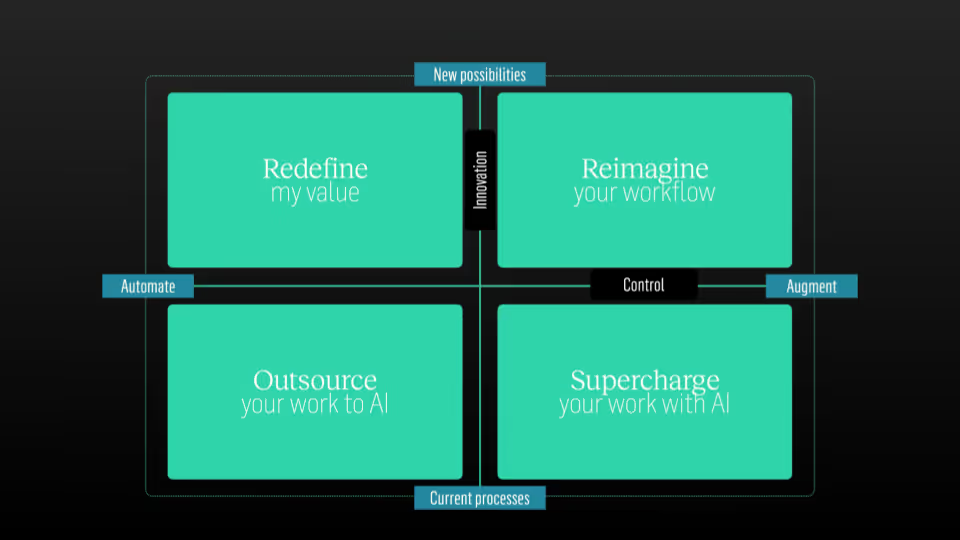
For AI, we use a simple two-by-two to stretch our thinking:
- Bottom left: what can we automate?
- Bottom right: how can we supercharge our existing work?
- Top right: how could we reimagine the way we work?
- Top left: how could we even redefine the value we bring to customers or to the world?
Most concrete use cases start in the bottom quadrants. That is fine. But we regularly force ourselves, as teams, to talk about the top quadrants, even if nothing “actionable” comes out immediately. It trains the muscle to look beyond task-level automation.
Then we try to make change real through a cycle:
- Pilot and quick wins
We pick promising ideas from the growth maps and turn them into small pilots. The goal is to learn fast, build confidence and accept that some things will fail. - Build team fluency
We invest time in making people comfortable with AI. Not just engineers, but everyone. How do you brief an agent? How do you judge its output? Where is the line between good help and blind trust? - Scale and integrate
When something works, we do the hard work of changing the process around it. That means looking at roles, handovers and metrics, not just dropping in a tool. - Monitor real impact
For each serious agent or AI workflow, we ask: what are we getting in return?
Our presales agent is a good example. It can help us draft proposals faster. That is nice. Let us say it saves 30 percent of the time.
The real question is: what do we do with that 30 percent of time? Do we write more proposals? Do we spend more time on complex deals? Do we improve quality? If we do nothing, we just make people a bit more comfortable without changing the outcome.
This is the kind of thinking we are still learning as we go. We call it the “messy middle” on purpose. It is not neat. But it is necessary if you want AI to show up in real numbers, not only in anecdotes.
From 95% Zero Return to the 5% Who Win
One (contested) MIT study that is often quoted says that 95 percent of organisations get zero measurable return from their AI pilots.
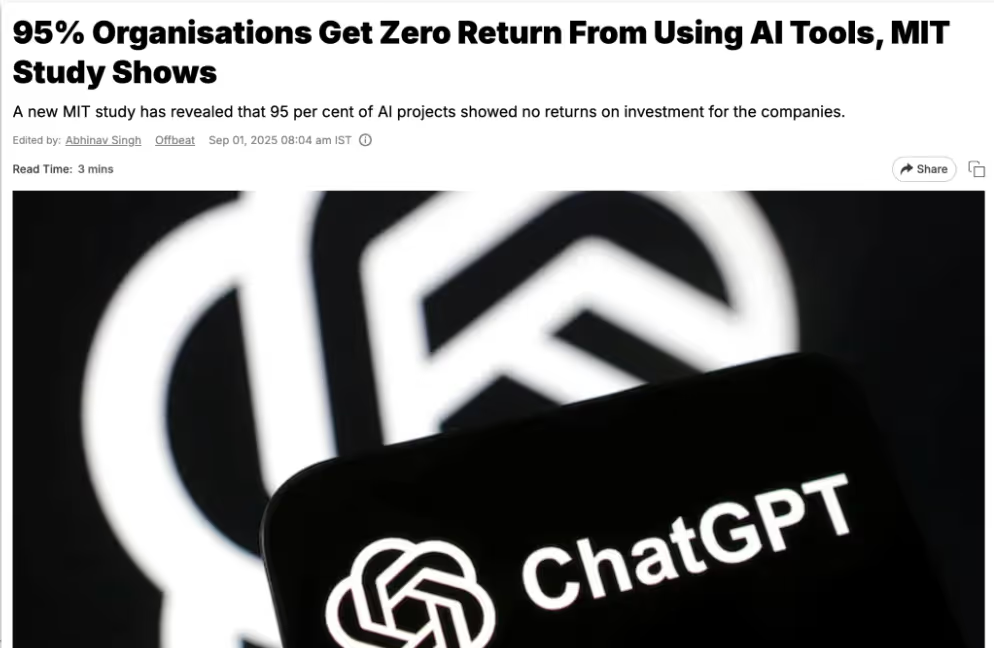
Most people stop reading there.
The same study also says that the remaining 5 percent are already creating millions in value. The technology is the same. The difference is how they change their organisation around it.
AI creates potential. To turn that potential into productivity, you need:
- Clear ownership of capabilities and their AI future;
- A shared platform to deploy and govern AI;
- A culture that treats transformation as ongoing work, not a one-off roadmap.
Closing Thoughts
At In The Pocket, we do not have all the answers. But we are constantly learning and adjusting, making mistakes along the way.if And we now have the structures that let us see what is happening and make changes where needed.
I do not think it will take us another ten or forty years to see AI in the productivity numbers. The urgency is higher, and we have learned from past waves.
The organisations that act now, and that are willing to live in the messy middle for a while, will be the ones in that 5 percent. The good news is that there is still a lot of room there.

Stay ahead
of the game.
Sign up for our monthly newsletter
and stay updated on trends, events
and inspiring cases.
Thank you! Your submission has been received!
Oops! Something went wrong while submitting the form.